
5 stories
·
0 followers

Kurt Vonnegut’s Term Paper Assignment from the Iowa Writers’ Workshop Teaches You to Read Fiction Like a Writer

1 Comment

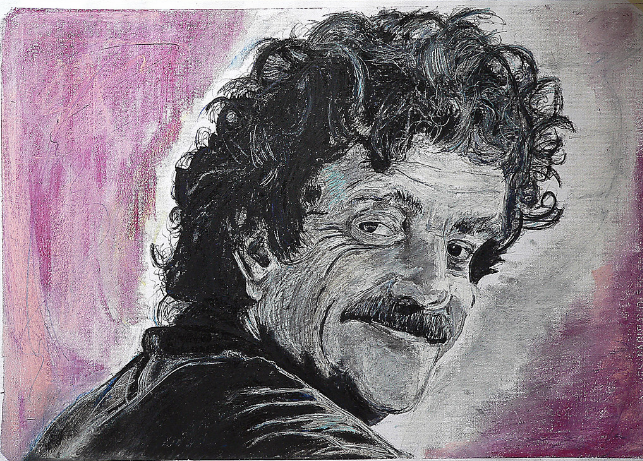
vonnegut drawing

Image by Daniele Prati, via Flickr Commons

I wish I’d had a teacher who framed his or her assignments as letters…

Which is really just another way of saying I wish I’d been lucky enough to have taken a class with writers Kurt Vonnegut or Lynda Barry.

There’s still hope of a class with Barry, aka Professor Chewbacca, Professor Old Skull, and most recently, Professor Drogo. Those of us who can’t get a seat at the Wisconsin Institute for Discovery, the Omega Institute, or the Clarion Science Fiction and Fantasy Writers’ Workshop can play along at home, using assignments she generously makes available in her books and on her Near-Sighted Monkey Tumblr.


Vonnegut fans long for this level of access, which is why we are doubly grateful to writer Suzanne McConnell, who took Vonnegut’s “Form of Fiction” (aka “Surface Criticism” aka “How to Talk out of the Corner of Your Mouth Like a Real Tough Pro”) course at the Iowa Writers’ Workshop in the mid-60s.

The goal was to examine fiction from a writer’s perspective and McConnell (who is soon to publish a book about Vonnegut’s advice to writers) preserved one of her old teacher’s term paper assignments—again in letter form. She later had an epiphany that his assignments were “designed to teach something much more than whatever I thought then…  He was teaching us to do our own thinking, to find out who we were, what we loved, abhorred, what set off our tripwires, what tripped up our hearts.”

For the term paper, the eighty students—a group that included John Irving, Gail Godwin, and Andre Dubus II—were addressed as “Beloved” and charged with assigning a letter grade to each of the fifteen stories in Masters of the Modern Short Story (Harcourt, Brace, 1955, W. Havighurst, editor).

(A decade and a half later, Vonnegut would subject his own novels to the same treatment.)

A noted humanist, Vonnegut instructed the class to read these stories not in an overly analytical mindset, but rather as if they had just consumed “two ounces of very good booze.”

The ensuing letter grades were meant to be “childishly selfish and impudent measures” of how much—or little—joy the stories inspired in the reader.

Next, students were instructed to choose their three favorite and three least favorite stories, then disguise themselves as “minor but useful” lit mag editors in order to advise their “wise, respected, witty and world-weary superior” as to whether or not the selected stories merited publication.

Here’s the full assignment, which was published in Kurt Vonnegut: Letters(Delacorte Press, 2012). And also again in Slate.

Beloved:

This course began as Form and Theory of Fiction, became Form of Fiction, then Form and Texture of Fiction, then Surface Criticism, or How to Talk out of the Corner of Your Mouth Like a Real Tough Pro. It will probably be Animal Husbandry 108 by the time Black February rolls around. As was said to me years ago by a dear, dear friend, “Keep your hat on. We may end up miles from here.”

As for your term papers, I should like them to be both cynical and religious. I want you to adore the Universe, to be easily delighted, but to be prompt as well with impatience with those artists who offend your own deep notions of what the Universe is or should be. “This above all …”

I invite you to read the fifteen tales in Masters of the Modern Short Story (W. Havighurst, editor, 1955, Harcourt, Brace, $14.95 in paperback). Read them for pleasure and satisfaction, beginning each as though, only seven minutes before, you had swallowed two ounces of very good booze. “Except ye be as little children …”

Then reproduce on a single sheet of clean, white paper the table of contents of the book, omitting the page numbers, and substituting for each number a grade from A to F. The grades should be childishly selfish and impudent measures of your own joy or lack of it. I don’t care what grades you give. I do insist that you like some stories better than others.

Proceed next to the hallucination that you are a minor but useful editor on a good literary magazine not connected with a university. Take three stories that please you most and three that please you least, six in all, and pretend that they have been offered for publication. Write a report on each to be submitted to a wise, respected, witty and world-weary superior.

Do not do so as an academic critic, nor as a person drunk on art, nor as a barbarian in the literary market place. Do so as a sensitive person who has a few practical hunches about how stories can succeed or fail. Praise or damn as you please, but do so rather flatly, pragmatically, with cunning attention to annoying or gratifying details. Be yourself. Be unique. Be a good editor. The Universe needs more good editors, God knows.

Since there are eighty of you, and since I do not wish to go blind or kill somebody, about twenty pages from each of you should do neatly. Do not bubble. Do not spin your wheels. Use words I know.

poloniøus

McConnell supplied further details on the extraordinary experience of being Vonnegut’s student in an essay forthe Brooklyn Rail:

Kurt taught a Chekhov story. I can’t remember the name of it. I didn’t quite understand the point, since nothing much happened. An adolescent girl is in love with this boy and that boy and another; she points at a little dog, as I recall, or maybe something else, and laughs. That’s all. There’s no conflict, no dramatic turning point or change. Kurt pointed out that she has no words for the sheer joy of being young, ripe with life, her own juiciness, and the promise of romance. Her inarticulate feelings spill into laughter at something innocuous. That’s what happened in the story. His absolute delight in that girl’s joy of feeling herself so alive was so encouraging of delight. Kurt’s enchantment taught me that such moments are nothing to sneeze at. They’re worth a story.             

via Slate

Related Content:

Kurt Vonnegut Diagrams the Shape of All Stories in a Master’s Thesis Rejected by U. Chicago

In 1988, Kurt Vonnegut Writes a Letter to People Living in 2088, Giving 7 Pieces of Advice

Kurt Vonnegut’s 8 Tips on How to Write a Good Short Story

Kurt Vonnegut Urges Young People to Make Art and “Make Your Soul Grow”

Ayun Halliday is an author, illustrator, theater maker and Chief Primatologist of the East Village Inky zine.  Her play Zamboni Godot is opening in New York City in March 2017. Follow her @AyunHalliday.

Kurt Vonnegut’s Prof. Kurt Vonnegut’s Delightful Term Paper Assignment from the Iowa Writers’ Workshop Teaches You Workshop: How to Read Fiction Like a Writer Writer: is a post from: Open Culture. Follow us on Facebook, Twitter, and Google Plus, or get our Daily Email. And don't miss our big collections of Free Online Courses, Free Online Movies, Free eBooksFree Audio Books, Free Foreign Language Lessons, and MOOCs.

Read the whole story
K_REY_C
3592 days ago
reply
Lovely
Share this story
Delete

The Third Self: Mary Oliver on Time, Concentration, the Artist’s Task, and the Central Commitment of the Creative Life

1 Share

“The most regretful people on earth are those who felt the call to creative work, who felt their own creative power restive and uprising, and gave to it neither power nor time.”


The Third Self: Mary Oliver on Time, Concentration, the Artist’s Task, and the Central Commitment of the Creative Life

“In the wholeheartedness of concentration,” the poet Jane Hirshfield wrote in her beautiful inquiry into the effortless effort of creativity, “world and self begin to cohere. With that state comes an enlarging: of what may be known, what may be felt, what may be done.” But concentration is indeed a difficult art, art’s art, and its difficulty lies in the constant conciliation of the dissonance between self and world — a difficulty hardly singular to the particular conditions of our time. Two hundred years before social media, the great French artist Eugène Delacroix lamented the necessary torment of avoiding social distractions in creative work; a century and a half later, Agnes Martin admonished aspiring artists to exercise discernment in the interruptions they allow, or else corrupt the mental, emotional, and spiritual privacy where inspiration arises.

But just as self-criticism is the most merciless kind of criticism and self-compassion the most elusive kind of compassion, self-distraction is the most hazardous kind of distraction, and the most difficult to protect creative work against.

How to hedge against that hazard is what beloved poet Mary Oliver (b. September 10, 1935) explores in a wonderful piece titled “Of Power and Time,” found in the altogether enchanting Upstream: Selected Essays (public library).

Mary Oliver
Mary Oliver

Oliver writes:

It is a silver morning like any other. I am at my desk. Then the phone rings, or someone raps at the door. I am deep in the machinery of my wits. Reluctantly I rise, I answer the phone or I open the door. And the thought which I had in hand, or almost in hand, is gone. Creative work needs solitude. It needs concentration, without interruptions. It needs the whole sky to fly in, and no eye watching until it comes to that certainty which it aspires to, but does not necessarily have at once. Privacy, then. A place apart — to pace, to chew pencils, to scribble and erase and scribble again.

But just as often, if not more often, the interruption comes not from another but from the self itself, or some other self within the self, that whistles and pounds upon the door panels and tosses itself, splashing, into the pond of meditation. And what does it have to say? That you must phone the dentist, that you are out of mustard, that your uncle Stanley’s birthday is two weeks hence. You react, of course. Then you return to your work, only to find that the imps of idea have fled back into the mist.

Oliver terms this the “intimate interrupter” and cautions that it is far more perilous to creative work than any external distraction, adding:

The world sheds, in the energetic way of an open and communal place, its many greetings, as a world should. What quarrel can there be with that? But that the self can interrupt the self — and does — is a darker and more curious matter.

Echoing Borges’s puzzlement over our divided personhood, Oliver sets out to excavate the building blocks of the self in order to understand its parallel capacities for focused creative flow and merciless interruption. She identifies three primary selves that she inhabits, and that inhabit her, as they do all of us: the childhood self, which we spend our lives trying to weave into the continuity of our personal identity (“The child I was,” she writes, “is with me in the present hour. It will be with me in the grave.”); the social self, “fettered to a thousand notions of obligation”; and a third self, a sort of otherworldly awareness.

The first two selves, she argues, inhabit the ordinary world and are present in all people; the third is of a different order and comes most easily alive in artists — it is where the wellspring of creative energy resides. She writes:

Certainly there is within each of us a self that is neither a child, nor a servant of the hours. It is a third self, occasional in some of us, tyrant in others. This self is out of love with the ordinary; it is out of love with time. It has a hunger for eternity.

Art by Maurice Sendak for a special edition of the Brothers Grimm fairy tales

Oliver contrasts the existential purpose of the two ordinary selves with that of the creative self:

Say you have bought a ticket on an airplane and you intend to fly from New York to San Francisco. What do you ask of the pilot when you climb aboard and take your seat next to the little window, which you cannot open but through which you see the dizzying heights to which you are lifted from the secure and friendly earth?

Most assuredly you want the pilot to be his regular and ordinary self. You want him to approach and undertake his work with no more than a calm pleasure. You want nothing fancy, nothing new. You ask him to do, routinely, what he knows how to do — fly an airplane. You hope he will not daydream. You hope he will not drift into some interesting meander of thought. You want this flight to be ordinary, not extraordinary. So, too, with the surgeon, and the ambulance driver, and the captain of the ship. Let all of them work, as ordinarily they do, in confident familiarity with whatever the work requires, and no more. Their ordinariness is the surety of the world. Their ordinariness makes the world go round.

[…]

In creative work — creative work of all kinds — those who are the world’s working artists are not trying to help the world go around, but forward. Which is something altogether different from the ordinary. Such work does not refute the ordinary. It is, simply, something else. Its labor requires a different outlook — a different set of priorities.

Part of this something-elseness, Oliver argues, is the uncommon integration of the creative self — the artist’s work cannot be separated from the artist’s whole life, nor can its wholeness be broken down into the mechanical bits-and-pieces of specific actions and habits. (Elsewhere, Oliver has written beautifully about how habit gives shape to but must not control our inner lives).

Echoing Keats’s notion of “negative capability,” Dani Shapiro’s insistence that the artist’s task is “to embrace uncertainty, to be sharpened and honed by it,” and Georgia O’Keeffe’s counsel that as an artist you ought to be “keeping the unknown always beyond you,” Oliver considers the central commitment of the creative life — that of making uncertainty and the unknown the raw material of art:

Intellectual work sometimes, spiritual work certainly, artistic work always — these are forces that fall within its grasp, forces that must travel beyond the realm of the hour and the restraint of the habit. Nor can the actual work be well separated from the entire life. Like the knights of the Middle Ages, there is little the creatively inclined person can do but to prepare himself, body and spirit, for the labor to come — for his adventures are all unknown. In truth, the work itself is the adventure. And no artist could go about this work, or would want to, with less than extraordinary energy and concentration. The extraordinary is what art is about.

In a sentiment that calls to mind Van Gogh’s spirited letter on risk-taking and how inspired mistakes move us forward, Oliver returns to the question of the conditions that coax the creative self into being:

No one yet has made a list of places where the extraordinary may happen and where it may not. Still, there are indications. Among crowds, in drawing rooms, among easements and comforts and pleasures, it is seldom seen. It likes the out-of-doors. It likes the concentrating mind. It likes solitude. It is more likely to stick to the risk-taker than the ticket-taker. It isn’t that it would disparage comforts, or the set routines of the world, but that its concern is directed to another place. Its concern is the edge, and the making of a form out of the formlessness that is beyond the edge.

Above all, Oliver observes from the “fortunate platform” of a long, purposeful, and creatively fertile life, the artist’s task is one of steadfast commitment to the art:

Of this there can be no question — creative work requires a loyalty as complete as the loyalty of water to the force of gravity. A person trudging through the wilderness of creation who does not know this — who does not swallow this — is lost. He who does not crave that roofless place eternity should stay at home. Such a person is perfectly worthy, and useful, and even beautiful, but is not an artist. Such a person had better live with timely ambitions and finished work formed for the sparkle of the moment only. Such a person had better go off and fly an airplane.

She returns to the problem of concentration, which for the artist is a form, perhaps the ultimate form, of consecration:

The working, concentrating artist is an adult who refuses interruption from himself, who remains absorbed and energized in and by the work — who is thus responsible to the work… Serious interruptions to work, therefore, are never the inopportune, cheerful, even loving interruptions which come to us from another.

[…]

It is six A.M., and I am working. I am absentminded, reckless, heedless of social obligations, etc. It is as it must be. The tire goes flat, the tooth falls out, there will be a hundred meals without mustard. The poem gets written. I have wrestled with the angel and I am stained with light and I have no shame. Neither do I have guilt. My responsibility is not to the ordinary, or the timely. It does not include mustard, or teeth. It does not extend to the lost button, or the beans in the pot. My loyalty is to the inner vision, whenever and howsoever it may arrive. If I have a meeting with you at three o’clock, rejoice if I am late. Rejoice even more if I do not arrive at all.

There is no other way work of artistic worth can be done. And the occasional success, to the striver, is worth everything. The most regretful people on earth are those who felt the call to creative work, who felt their own creative power restive and uprising, and gave to it neither power nor time.

Upstream is a tremendously vitalizing read in its totality, grounding and elevating at the same time. Complement it with Oliver on love and its necessary wildness, what attention really means, and the measure of a life well lived, then revisit Jane Hirshfield on the difficult art of concentration.


donating = loving

Bringing you (ad-free) Brain Pickings takes me hundreds of hours each month. If you find any joy and stimulation here, please consider becoming a Supporting Member with a recurring monthly donation of your choosing, between a cup of tea and a good dinner.


newsletter

Brain Pickings has a free weekly newsletter. It comes out on Sundays and offers the week’s most unmissable reads. Here’s what to expect. Like? Sign up.

Read the whole story
K_REY_C
3602 days ago
reply
Share this story
Delete

Traffic Is Fake, Audience Numbers Are Garbage, And Nobody Knows How Many People See Anything

1 Comment

How many living, breathing human beings really read Techdirt? The truth — the most basic, rarely-spoken truth — is that we have no earthly idea. With very few exceptions, no media property big or small, new or old, online or off, can truly tell you how big its audience is. They may have never thought about it that way — after all, we all get as close as we can to what we think is a reasonably accurate estimation, though we have no way of confirming that — but all these numbers are actually good for (maybe) is relative comparisons. What does it really mean when someone says "a million people" saw something? Or ten or a hundred million? I don't know, and neither do you. (Netflix might, but we'll get to that later.)

Where should we start? How about this: internet traffic is half-fake and everyone's known it for years, but there's no incentive to actually acknowledge it. The situation is technically improving: 2015 was hailed (quietly, among people who aren't in charge of selling advertising) as a banner year because humans took back the majority with a stunning 51.5% share of online traffic, so hurray for that I guess. All the analytics suites, the ad networks and the tracking pixels can try as they might to filter the rest out, and there's plenty of advice on the endless Sisyphean task of helping them do so, but considering at least half of all that bot traffic comes from bots that fall into the "malicious" or at least "unauthorized" category, and thus have every incentive to subvert the mostly-voluntary systems that are our first line of defence against bots... Well, good luck. We already know that Alexa rankings are garbage, but what does this say about even the internal numbers that sites use to sell ad space? Could they even be off by a factor of 10? I don't know, and neither do you. Hell, we don't even know how accurate the 51.5% figure is — it could be way off... in either direction.

Okay, so what about TV ratings? Well, there's a reason they've been made fun of on the shows themselves for as long as our culture has been able to handle "meta" jokes without getting a headache. Nielsen ratings in their classic form are built on monitoring such a tiny sample of households that the whole country's viewing profile can probably be swayed because someone forgot to turn off the TV before going on vacation. They sucked before DVRs and digital distribution began transforming the single household television into a quaint anachronism, and now it's just chaos. Nielsen was slow to catch up with DVRs, and now the TV industry juggles scattered measurements including three or seven days of viewing beyond live air, and constantly complains that the ratings are off — specifically, that they're too low. And they might be right, in the sense that they are too low by comparison to the garbage ratings from the pre-digital age that everyone eventually embraced as a standard for relative rankings. How big are these audiences really, in terms of real living breathing human beings? I don't know, and neither do you.

YouTube view counts? Subject to all the same fake internet traffic problems, plus the fact that there's an opaque system for supposedly ignoring too-short incomplete views according to the genre and nature of the video, but good luck finding out how accurate that is. Channel operators know their length-of-view statistics, but you don't see them bandying them about much. Plus, how often have you heard public view counts casually referred to as the number of "people" who watched something, even though (especially when it comes to short-and-cute viral animal hits and their ilk) the bulk of them probably come from obsessive re-watching? Yeah.

So what about Facebook stats? Everything from impressions to simultaneous live video viewers is padded out by the most transient of idly-scrolling-through-the-newsfeed interactions. Twitter followings and tweet stats? Dig into the bowels of any list of followers, or any trending link, and see how much of it is mindless bots. Print readerships? Don't even get me started. Did you know it's common practice for newspapers to calculate their readership by applying a multiplier to their actual circulation, to account for an imaginary surplus of "readers per copy"? Yes, that soggy "local" paper that's been sitting out in the rain on your porch for two days, and that only exists to give them an excuse to deliver flyers to your door, is not only being counted — it's probably being counted five times. So are all the free/cheap copies that big national papers give to hotels. Oh, and when these companies distribute multiple publications in different channels — with newspapers, magazines and paywalled websites all being given away with each other as free cross-subscriptions, in order to pad out all three subscriber numbers — they add them all up and then try to determine the actual number of individual people they are reaching. How? By applying an opaque "deduplication" formula. I once pressed a newspaper's stats person about what this formula could possibly entail, but details were not forthcoming — because I suspect they just knock off 20% and call it a day, despite the fact that the magazine is distributed inside the newspaper whose audience they are supposedly "deduplicating" it from, and half the website subscriptions were free add-ons with print delivery. That's awfully generous when the truth is they don't know, and neither do I, and neither do you.

So who does know how big of an audience they really have? Well, maybe Netflix, Amazon and other digital subscription services. Their paywalls insulate them from the bulk of random bot traffic, and their proprietary ecosystems give them the ability to closely monitor all activity. Netflix, of course, is famously secretive about viewer numbers and insists on the inaccuracy of those who claim to have worked them out. The most common assumption is that they do this to avoid giving content creators too much leverage, and because the data can be seen as a valuable commodity — but I propose another reason: Netflix's likely-more-accurate statistics, if made public, would have zero context in the topsy-turvy world of nonsense TV ratings. They would probably look exceptionally low, giving the legacy bosses who would like nothing more than to downplay the importance of digital distribution (and there are as many of those as there are record execs who can't spell mp3) a chance to project whatever narrative they wanted onto the numbers.

So why does any of this matter? Because advertising is a multibillion dollar industry, and whenever an industry is worth that much, you have to ask: is that because there are billions of dollars of worthwhile transactions happening, or because every bloodsucker in a ten-industry radius wanted in on the action? So, so much of the advertising industry is pure waste. How much exactly is as impossible to determine as the audience sizes themselves. This is hardly a new idea (in fact it's a century-old quote) but it's probably more true now than ever, despite the fact that in theory technology could have delivered us from uncertainty.

Finally, what can be done about this? There's no simple answer, and maybe no answer at all. Here at Techdirt, we've been working to come up with good advertising solutions by focusing almost entirely on what we know our community likes and might be interested in (as in, our real community of people who talk in our comments and we can say, with confidence, exist) and paying less attention to raw numbers — both a luxury and a necessity for a smaller publication, depending on how you look at it. That's not always easy though, as we face an advertising industry ruled by metrics, where there are often ten spreadsheet-wielding interns between us and someone who might actually care about our creativity. In our experiments with more traditional algorithmic display advertising to monetize the raw traffic numbers we do have, we keep running up against what appears to be a universal truth: the bulk of the global internet ad ecosystem runs on trash. Gigantic prestigious online media brands can sell display campaigns straight to the same people who buy Superbowl ads — everyone else receives a hundred pitches a week from new ad networks that claim to deliver great, relevant content but in fact litter your site with ads for fad diets and ambulance-chasers (at best). And this lowest-common-denominator filler appears to be the only reliably successful form of internet advertising! At least, it never goes away when the good stuff does, and the proud quality networks eventually embrace their roles as crap-peddlers. "Good" internet advertising is a rickety ship navigating an endless roiling ocean of spam, clickbait and outright fraud — but it couldn't float at all without it.

I realize I've painted a grim picture, but these are (more or less) the facts. I'm surely wrong in some of my guesses, but like everything discussed here, nobody knows how wrong or in which direction. We'll never even really know how many people read this — we'll just have a vague estimate that can be compared to other posts on Techdirt. But for now that's the reality, so maybe more people should stop worrying about the supposed size of their audience, and focus on making the content they want to make.


Permalink | Comments | Email This Story
Read the whole story
K_REY_C
3616 days ago
reply
Lovely
Share this story
Delete

The Rocket Book: A Conceptually Ingenious, Stunningly Illustrated 1912 Children’s Book About Urban Living

1 Comment

An irreverent wink at the challenge of separate lives sharing space in the city.


The Rocket Book: A Conceptually Ingenious, Stunningly Illustrated 1912 Children’s Book About Urban Living

“How alive the city is,” Alfred Kazin exclaimed in his journal in the late 1950s, “how alive, how alive, how alive. Each of those windows has someone behind it… A network of people, a living field — each grass a soul, each grass alive.”

But this elated sense of the city as an arena for communion with humanity didn’t exist a mere generation earlier. It was made possible by the rapidly accelerating pace of urbanization in the early 1900s — by the end of the eighteenth century, only about one out of twenty families in America lived in cities, but by the second decade of the twentieth, the proportion had grown tenfold to one in two. Urban living also meant changing not only where people lived but how they lived — single-family homes were gradually replaced by large apartment buildings, where neighbors had to contend with maintaining separate lives in extreme proximity to one another.

That’s what Peter Newell (March 5, 1862–January 15, 1924), an artist endowed with Arthur Rackham’s superb draughtsmanship and Dr. Seuss’s irreverent wit, explores in his 1912 gem The Rocket Book (public library).

newell_rocketbook1

In this consummately illustrated story, the janitor’s mischievous son lights a rocket hidden in the basement of a towering building, a skyscraper by the era’s standards, and sends it blasting vertically upward. Each page depicts the ruckus the rocket creates as it rips through the twenty-one floors — through a writer’s typewriter, through a taxidermist’s prized walrus head, through the silverware drawer as a burglar is about to ransack it — until a can of frozen cream extinguishes it at the very top.

newell_rocketbook2

newell_rocketbook3

newell_rocketbook4

newell_rocketbook5

newell_rocketbook6

In shooting up through the all building’s apartments, the rocket pierces the artificial architectural boundaries between separate lives and becomes a vehicle for what E.B. White would later call “the gift of privacy with the excitement of participation” in his superb meditation on what makes a great city. Like in Newell’s conceptually groundbreaking book The Hole, published four years earlier, an actual die-cut hole punctures the physical book in the same spot on every page as the rocket blasts its way through the twenty-one stories.

newell_rocketbook7

newell_rocketbook8

newell_rocketbook9

Woven into the timelessly delightful verses are the particular predicaments and norms of the time — the inhabitants of the various flats bear names as charmingly dated as Fritz, Mamie, Burt, and Gus; in the seventh flat, a woman plays the piano badly to please a man; we’re told that the man in the sixteenth flat is “a stupid guy” because he is unable to awaken early enough without an alarm clock, thus betraying the new cultural ideals of speed and productivity.

newell_rocketbook10

newell_rocketbook11

newell_rocketbook12

newell_rocketbook13

newell_rocketbook14

newell_rocketbook15

newell_rocketbook16

newell_rocketbook17

newell_rocketbook18

newell_rocketbook19

newell_rocketbook20

newell_rocketbook21

newell_rocketbook22

Complement Newell’s The Rocket Book, which is in the public domain and available as a free ebook from the Library of Congress, with legendary graphic designer Paula Scher’s The Brownstone — a lovely vintage children’s book offering a very different, equally delightful take on the challenge of compressing multiple lives into a space as confined as an urban apartment building.

Thanks, Clive


donating = loving

Bringing you (ad-free) Brain Pickings takes me hundreds of hours each month. If you find any joy and stimulation here, please consider becoming a Supporting Member with a recurring monthly donation of your choosing, between a cup of tea and a good dinner.


newsletter

Brain Pickings has a free weekly newsletter. It comes out on Sundays and offers the week’s most unmissable reads. Here’s what to expect. Like? Sign up.

Read the whole story
K_REY_C
3670 days ago
reply
Lovely
Share this story
Delete

Patternicity: Dreamy Diagrams and Lyrical Visualizations of the Eccentric Details of Daily Life in the City

1 Comment

An abstract love letter to the art of paying attention.


Patternicity: Dreamy Diagrams and Lyrical Visualizations of the Eccentric Details of Daily Life in the City

“How we spend our days is, of course, how we spend our lives,” Annie Dillard memorably wrote. Out of the way we attend to the minutia of our days emerges the grand scheme of our lives and the grain of that attention renders the texture of our existence. But the great paradox of it all is that we are wired to miss the majority of what goes on around us.

Turkish industrial designer and School of Visual Arts graduate student Yasemin Uyar explores this paradox with equal parts playfulness and wholehearted curiosity in Patternicity — her part in the annual 100 Days Project initiative by Debbie Millman’s SVA Masters in Branding program, which tasks students with envisioning a creative operation, performing it for one hundred consecutive days, and documenting the ongoing process in a public medium.

patternicity1

patternicity3

patternicity2

Uyar sees her project as an act of “discovering patterns in overlooked noise through observation.” Each day, she turns to one such neglected aspect of her daily life in New York City — from the geography of smell to women’s hairstyles to the distribution of puddles on a rainy day to the correlation between the number of customers and the number of menu options at a pizza shop — and renders it in a lyrical, abstract visualization braiding observation, discovery, and storytelling. The resulting dreamy diagrams are less about giving information than about celebrating the very act of paying attention — that supreme conduit to aliveness.

patternicity22

patternicity8

patternicity5

Partway between the aesthetic splendor of Giorgia Lupi and Stefanie Posavec’s Dear Data and the marvelously eccentric data-point selections of Denis Wood’s Everything Sings, the project is a wonderful exercise in what Lynda Barry calls “being present and seeing what’s there.”

patternicity4

patternicity6

patternicity7

patternicity9

patternicity10

patternicity11

patternicity12

patternicity13

patternicity14

patternicity15

patternicity16

patternicity17

patternicity18

patternicity19

patternicity26

patternicity27

patternicity20

patternicity21

patternicity23

patternicity24

patternicity25

Follow Uyar’s project on Instagram and complement it with Lynda Barry’s field guide to keeping a visual diary, cognitive scientist Alexandra Horowitz on the art of noticing, and John Ruskin on how drawing trains you to see the world more clearly.


donating = loving

Bringing you (ad-free) Brain Pickings takes me hundreds of hours each month. If you find any joy and stimulation here, please consider becoming a Supporting Member with a recurring monthly donation of your choosing, between a cup of tea and a good dinner.


newsletter

Brain Pickings has a free weekly newsletter. It comes out on Sundays and offers the week’s most unmissable reads. Here’s what to expect. Like? Sign up.

Read the whole story
K_REY_C
3719 days ago
reply
Lovely work
Share this story
Delete